The uplift of in‑ground swimming pools is a recurring phenomenon in Quebec, particularly in connection with winterization activities and freeze–thaw cycles. This vertical movement generally results from a loss of equilibrium between the mass of the structure and the pressures exerted by the surrounding environment.
In this context, the following summarizes the physical mechanisms and hydrogeotechnical conditions typically involved in pool uplifts, as well as the installation and maintenance parameters that influence the structural response of swimming pools and that must be considered in a legal expert assessment.
1. Fluid Mechanics and Archimedes’ Principle
The uplift of a swimming pool is not a random movement, but a direct physical response to a loss of static equilibrium.
Archimedean Buoyancy Acting on the Soil
Any buried structure displaces a volume of soil. When this soil becomes saturated, groundwater exerts an upward pressure on all submerged surfaces. This is Archimedes’ principle—the same phenomenon that allows a boat to float on water. In engineering, the stability of a swimming pool is assessed by comparing its total weight (structure and the volume of water it contains) to the force exerted by groundwater (based on the volume of groundwater “occupied” by the pool).
The Buoyancy Threshold
An in‑ground pool therefore behaves like a boat hull. As long as the weight of the pool (the ballast) exceeds the pressure exerted by groundwater, the structure remains stable within the soil. However, if the soil becomes saturated and the water level inside the pool is too low, the upward force (uplift) becomes dominant, leading to a vertical—often sudden—displacement of the pool.
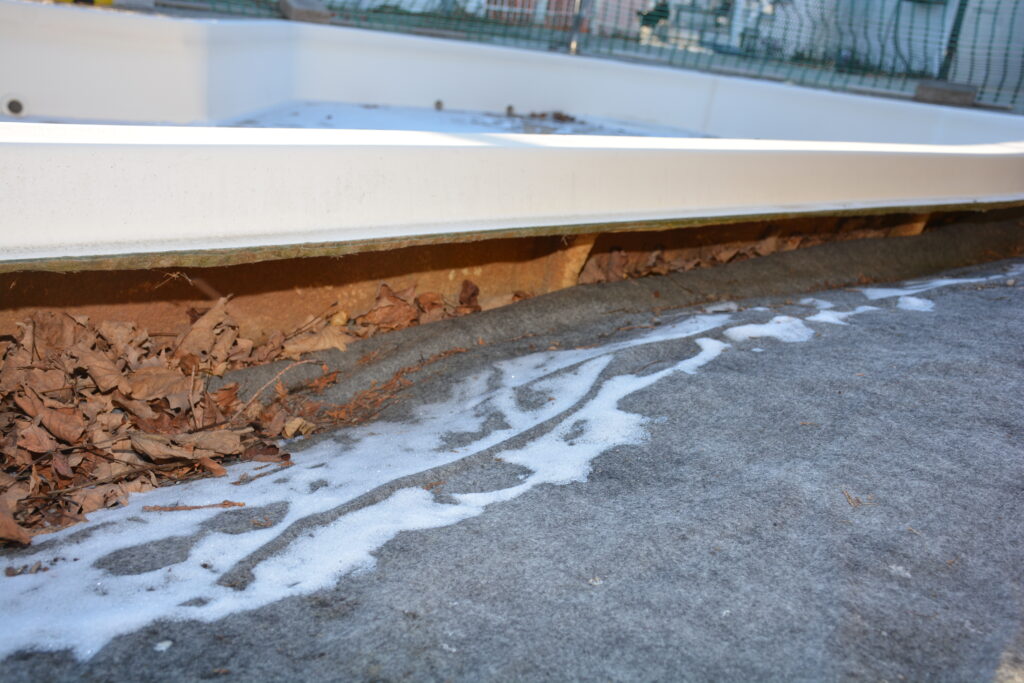
2. Influence of the Quebec Geotechnical Context
The geology of the St. Lawrence Valley imposes potentially severe constraints on buried structures.
The Issue of Clay Soils
A large portion of Quebec’s territory is underlain by surface clay soils. These soils are characterized by very low infiltration capacity. Unlike sandy or gravelly soils, which allow water to drain freely, clay retains moisture or water within the soil mass and promotes hydrostatic pressures on structures built in these soils, such as in‑ground swimming pools.
Freeze–Thaw Effects
During winter, water retained in clay soils around the pool may freeze and cause lateral and/or vertical pressure movements on the pool structure. During the spring thaw, which does not necessarily occur uniformly, the upper soil layer thaws first and becomes saturated with meltwater, while the deeper layers remain frozen and impermeable. This situation promotes a “bathtub effect” in which meltwater remains trapped around the pool and may increase localized hydrostatic pressure against the structure.
3. Pool Design and Installation Parameters
The long‑term performance of a swimming pool largely depends on the management of groundwater around the structure.
Peripheral Drainage Systems
During pool construction, peripheral drainage is essential and must be installed at the base of the slab (pool floor) and connected to a functional outlet (for permanent drainage) or to a sump well (for intermittent drainage needs), depending on the depth of the groundwater table to be managed. A crushed, clogged, or improperly elevated drain loses its decompression function, allowing pressure to accumulate beneath the structure.
Backfill Material
The choice of backfill material is also a determining factor. The use of clean stone (¾‑inch crushed stone) creates a high‑permeability zone around the pool. Sand backfill can also achieve the same objective by allowing water to migrate quickly toward the drainage system rather than remaining stagnant against the pool walls. Conversely, the use of excavation spoil (often clayey) promotes saturation and water retention.
4. Pool Maintenance and Winterization Activities
When analyzing the cause of a loss event, the operational condition of the site at the time of the event is a major technical parameter.
Water Level Management in the Pool (Ballast)
The water contained in the pool is the simplest and most important stability factor. Lowering the water level for winterization or seasonal cleaning reduces the overall mass of the structure. If this action coincides with a period of heavy rainfall or snowmelt, the safety factor may drop below unity, leading to pool uplift if drainage is inadequately designed or used. During pool winterization, the procedure involves lowering the water level to a specific height relative to the pool coping or to the return nozzles of the filtration and sanitation system. This lowering of the water level assumes that drainage around the pool is adequate to prevent groundwater uplift forces from exceeding the combined weight of the pool and its contents. Compliance with the winterization procedure—generally provided by the pool contractor—therefore remains essential.
The Sump Well: A Safety Valve
The sump well is a critical drainage component, allowing monitoring of groundwater levels around the pool and, more importantly, enabling mechanical lowering of these levels using a submersible pump as needed. This is particularly important during spring snowmelt, periods of intense or prolonged summer rainfall, or maintenance activities requiring temporary lowering of groundwater levels or emptying of the pool.
5. Cause Investigation
When movement or deformation of an in‑ground swimming pool occurs, the engineer will look for specific physical evidence to confirm the extent and origin of the movement. This includes signs of differential vertical displacement, deformation of the pool walls or floor, abnormal tension in the liner, or misalignment of pool equipment. Determining the cause also relies on temporal correlation between environmental conditions and the appearance of damage, such as winterization dates, other maintenance activities, the timing of damage observation, or specific weather events. Lastly, examination of the pool and its equipment can also help reconstruct the sequence of the event and distinguish an unforeseeable accidental occurrence from a chronic drainage issue.
Conclusion: Balance Between Natural Forces and Design
The uplift of an in‑ground swimming pool results from the interaction between powerful hydraulic forces and the structural characteristics of the pool. While Quebec’s climate imposes severe environmental constraints, the long‑term performance of a pool depends on three key pillars: drainage‑oriented design, rigorous installation, and proper maintenance.

Civil Engineer